
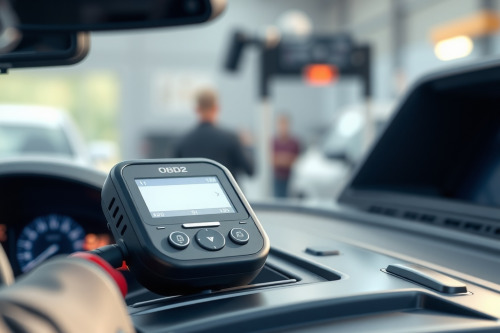
Diagnosing modern drivability faults without commanding modules directly turns troubleshooting into expensive guesswork. In my 15 years servicing European and domestic platforms, static sensor data often conceals physical hardware failures. An OBD2 scanner with bi-directional control eliminates this uncertainty by forcing components to cycle on command. Connecting to the vehicle harness allows you to pinpoint malfunctioning circuits in minutes.
Mechanics of an OBD2 scanner with bi-directional control
Standard scan tools operate as passive listeners. They request Parameter IDs and read what the engine control module chooses to report. An OBD2 scanner with bi-directional control changes this dynamic completely. The diagnostic tablet acts as a temporary master controller on the data bus.
It transmits targeted interrogation frames using the standard CAN bus communication protocol. These messages request the recipient module to override internal software logic and drive an output stage directly. When you prompt a cooling fan relay to engage, the scan tool sends an explicit request packet to the body control module. The module closes the ground circuit instantly. If the fan spins, you confirm the power feed, relay contacts, ground paths, and motor windings function correctly. You bypass the temperature sensor and cooling algorithms entirely.
Executing ECU actuator testing on the shop floor
Static resistance measurements waste precious diagnostic time. We run ECU actuator testing under load to expose thermal failures and intermittent open circuits. During a cylinder misfire diagnosis on a direct-injected platform, passive fuel trim data rarely identifies whether a fault stems from an injector driver or a fouled nozzle.
Connect your scanner and initiate an injector buzz test or an individual cylinder cutoff. Listen for the distinct metallic click of the pintle moving inside the housing. This active routine proves the high-side driver inside the powertrain module is cycling output current. We apply this same verification method to an evaporative emissions system. Command the EVAP solenoid valve to toggle between 0% and 100% duty cycle while monitoring manifold vacuum. A healthy valve responds with immediate vacuum drop and audible actuation. When the scanner signals actuation but flow remains static, your issue is mechanical blockage or coil fatigue.
Deploying active test commands for systematic isolation
Fault isolation requires separating command authority from electrical distribution. Deploying active test commands allows you to cut standard diagnostic trees in half. Consider an air conditioning compressor clutch that refuses to engage. A basic code reader lists an open circuit code and nothing more.
You must isolate the problem quickly. Command the A/C clutch relay directly through the diagnostic tool. If the clutch plate snaps against the pulley with 12V applied, your entire relay circuit, fuse block, and field coil are sound. Shift your focus upstream immediately. The engine computer might be inhibiting engagement due to refrigerant line pressures reading below 2.8 bar or above 28 bar. Conversely, if commanding the relay yields zero response, grab your digital multimeter. Probe pin 85 and pin 86 across the relay socket while toggling the software command. You'll locate the broken wire or blown 15A fuse within 3 minutes.
Field failure scenarios and component functional test limits
Bi-directional routines are powerful, but they operate under strict physical constraints. A component functional test cannot execute if safety preconditions fail inside control module memory. We frequently observe technicians condemning functional modules simply because an active test refused to initiate.
Vehicle manufacturers program rigid software interlocks. If system battery voltage drops below 12.2V, modern steering and ABS modules automatically abort active routines. Maintain clean power with a 70A battery maintainer during all testing. High engine speed, active transmission gear engagement, or existing critical diagnostic trouble codes will also suppress command overrides. Understand what your tool displays during an aborted sequence. A message stating conditions not correct points to vehicle operating states, not hardware defects.
Maximizing shop efficiency with an OBD2 scanner with bi-directional control
Unnecessary part replacements destroy shop profitability. An OBD2 scanner with bi-directional control serves as your primary defense against shotgun part replacement. Swapping a $600 electronic throttle body because of sluggish response is unacceptable when a recalibration and sweep test take 90 seconds.
We run bi-directional sweeps across electronic throttle plates to plot sensor tracking correlation. Command throttle opening percentages from 5% to 90% in fixed 10% increments. Observe the dual potentiometer voltages on your live data graph. Sensor 1 should rise smoothly toward 4.5V while Sensor 2 declines proportionally toward 0.5V. If the physical blade sticks or the carbon track displays dropouts, you possess undeniable physical proof of component degradation. You quote the replacement with absolute confidence.
Field deployment verdict and verification guidelines
Integrating an OBD2 scanner with bi-directional control into your daily workflow separates guesswork from rigorous engineering diagnostics. Before purchasing hardware, verify protocol coverage for high-speed CAN networks, DoIP, and secure gateway access for newer platforms. Always connect stable supplementary power to maintain 13.5V across the bus during extended actuator sweeps. Test outputs methodically, verify live electrical responses, and stop swapping parts blindly. Upgrade your diagnostic arsenal today to command your vehicle systems with precision.