
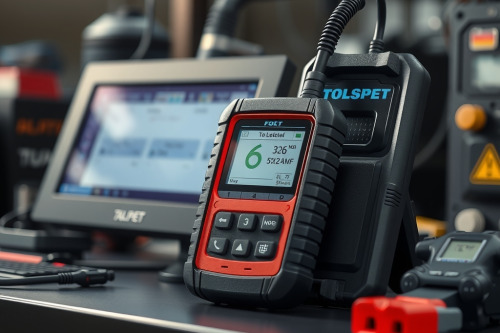
Relying on a cheap code reader will quickly hit a wall when diagnosing modern CAN bus communication faults or intermittent sensor dropouts. I spent 12 years troubleshooting complex automotive electrical architectures in busy repair bays. Deciding between a professional vs basic OBD2 scanner comes down to whether you only need simple fault resets or full subsystem command capabilities. Choose the wrong hardware, and you waste shop hours swapping good parts blindly.
Fundamental Hardware Differences: Professional vs Basic OBD2 Scanner
Basic hand-held code readers run on modest 8-bit or 32-bit microcontrollers. They pull 12V operating power directly from pin 16 of the data link connector. These units weigh under 200g, fit in a glovebox, and communicate strictly over standard ISO 15765-4 protocols. Their processing bandwidth remains tiny. They parse standard generic emission parameters slowly.
Professional diagnostic tablets pack multi-core industrial processors, dedicated graphics chips, and minimum 4GB RAM. Built-in lithium-ion battery packs keep them powered through engine cranking dropouts down to 6V. Drop tests from 1.5m onto concrete prove their durability in heavy shop environments. Wireless vehicle communication interfaces (VCI) transmit live frame data via 5GHz Wi-Fi or Bluetooth 5.0 up to 30m away.
Processing Speed and Bus Architecture
Diagnostic communication depends on network throughput. Modern vehicles run multiple baud rates simultaneously. While powertrain CAN operates at 500 kbps, modern chassis systems leverage CAN FD at 2 Mbps to 5 Mbps. Basic tools lack the physical transceivers to listen to high-speed CAN FD channels. Professional units feature multiplexed pin routing that physically remaps communication lines to interrogate gateway modules directly.
Screen Interface and Ruggedization
Working under shop lighting requires high display luminance. Basic units feature monochrome or 2.8-inch low-resolution LCDs displaying 2 to 3 lines of text. Professional scanners employ 8-inch to 12-inch capacitive touchscreens rated at 800 nits minimum. Technicians navigate live data plots with greasy nitrile gloves without input lag. Heavy rubber bumpers protect the internal motherboards from fluid leaks and shop impacts.
Protocol Support and ECU Subsystem Access
A standard emission reader only inspects SAE J1979 modes 01 through 0A. This window shows powertrain data strictly mandated by government emissions standards. It'll not communicate with supplemental restraint systems (SRS), anti-lock brakes (ABS), or body control modules (BCM). If an electric parking brake caliper freezes, a basic tool stays blind.
Full-system scan tools read both standard and proprietary manufacturer networks. Modern European and domestic platforms split functions across 40 to 90 individual electronic control units. Professional platforms communicate directly across LIN, K-Line, standard CAN, CAN FD, and Ethernet DoIP lines. They reveal localized fault codes hidden deep inside radar cruise control, battery management units, and transmission controllers.
Sensor PIDs and Refresh Rates
Troubleshooting intermittent drivability issues demands high data capture speeds. Basic tools query the powertrain module sequentially at roughly 2 to 5 parameter updates per second. Graphing four live data parameters drops the refresh rate to a crawl. You'll completely miss transient voltage drops on an oxygen sensor circuit.
Advanced platforms poll live data via optimized manufacturer-specific data streams at 30 to 50 samples per second. Technicians can plot 8 separate PIDs on a merged timeline. Pinpointing throttle position sensor sweep dropouts becomes instantaneous. To analyze raw electrical signal integrity beyond software PID conversion, technicians hook up an external oscilloscope to confirm true wave shape performance.
Diagnostic Depth: Bi-Directional Controls and Actuation Tests
Basic diagnostic tools only listen; they can't talk back to the car. They report stored DTC status and freeze frame snapshots. When an actuator fails, passive listening gives zero definitive proof of where the fault lies. You're left guessing whether the failure originates in the wiring, the driver stage inside the computer, or the component itself.
Bi-directional control changes everything. Professional diagnostic scan platforms override factory control routines to command specific components on demand. You can toggle cooling fan relays between 10%, 50%, and 100% duty cycles directly from the touchscreen. You can command variable valve timing solenoids to pulse or trigger individual fuel injector cuts while monitoring engine balance.
Calibration and Adaptation Routines
Swapping mechanical components modernly requires digital handshakes. Replacing a modern electronic throttle body requires an idle air relearn. Replacing a steering rack demands zero-point calibration of the steering angle sensor. Basic code readers possess zero capability to perform routine service resets. Professional units execute throttle relearns, diesel particulate filter (DPF) static regenerations, and brake bleed procedures in under 5 minutes.
ECU Coding vs Routine Diagnostics
Repairs often halt when new parts require initialization. Installing a new battery on modern charging systems demands battery registration to reset the charging map. Failure to perform this action boils the new battery within 6 months. High-end scan tools handle variant coding and module initialization. Entry-level units leave you stranded at the component installation stage.
Real-World Diagnostic Workflow Comparison
Consider a vehicle arriving with a P0300 random misfire code. Plug in a basic $35 code reader. It reads the code and displays freeze frame data showing vehicle speed and engine RPM at the trigger point. The basic reader cannot show individual cylinder misfire counters. You must swap ignition coils between cylinders and drive the vehicle repeatedly to see if the code moves.
Now connect a professional unit. You pull live manufacturer PIDs displaying individual misfire counters for all cylinders in real time. Cylinder 3 registers 42 events within 60 seconds, while the others register 0. You run an active cylinder balance test, shutting off fuel to cylinder 3 to measure RPM drop. Total diagnostic time drops from 45 minutes to 4 minutes.
Cost, Licensing Fees, and Maintenance Overhead
Budget constraints often dictate initial tool selection. Basic scanners cost anywhere from $20 to $80. They require no annual subscriptions, no internet connections, and zero operating software maintenance. Buy one once, throw it in the tool cart, and it functions identically 8 years later on any standard 16-pin port.
Professional scan tools carry entry prices between $800 and $4500. Beyond hardware expense, recurring annual software licenses run from $300 to $1200 depending on platform coverage. Skipping update subscriptions locks the technician out of secure gateway access (SGW) on newer vehicle architectures. You must balance this ongoing overhead against billable shop hours saved on labor.
Professional vs Basic OBD2 Scanner: The Final Buy Decision
Selecting the right hardware hinges entirely on your daily diagnostic goals. Choose a basic OBD2 scanner if your only goal is reading generic check engine light faults, confirming vehicle state inspection monitor readiness, and clearing minor powertrain codes on personal weekend vehicles. It represents an inexpensive, dependable insurance policy against deceptive repair estimates.
Invest in a professional vs basic OBD2 scanner setup if you handle component replacements, complex network diagnostics, or routine maintenance operations like electronic brake service. the option to command actuators, relearn sensor adaptations, and view fast multi-channel live data will pay for the hardware within 5 complex jobs. Evaluate your daily diagnostic volume, calculate software maintenance capabilities, and secure the hardware platform that matches your repair scope.