
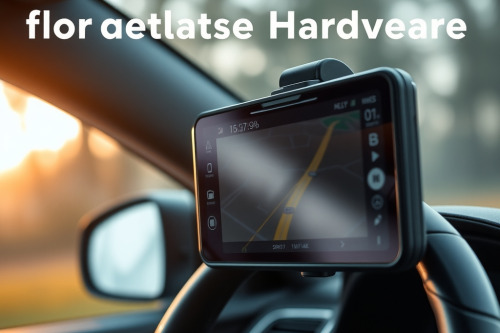
Cheap dashboard tablets fail the second your vehicle drops into an urban canyon or extreme summer heat. Over 12 years bench-testing telematics rigs on remote interstates, I've seen driver-assist hardware lock up right when you need precision positioning. Finding the best gps navigation for car installations requires looking past marketing claims to inspect actual receiver sensitivity, thermal limits, and bus communication. Here's how to evaluate real navigation hardware before you waste cash on a bricked unit.
Why does dead reckoning matter in the best gps navigation for car?
Consumer smartphones rely almost entirely on line-of-sight satellite fixes. Enter a subterranean parking garage, a two-level tunnel, or a dense high-rise corridor, and the position marker drifts across adjacent city blocks. Serious road warriors cannot tolerate that kind of drift.
Hardware equipped with dead reckoning bridges the gap when satellites disappear. The system combines an internal 3-axis accelerometer and gyroscope module with direct vehicle speed pulses. Even if you lose satellite contact inside a 3km tunnel, the navigation processor calculates your exact trajectory based on distance and yaw angle. You stay on track without drifting onto phantom surface streets.
Inertial measurement versus software approximation
Budget hardware attempts to predict vehicle movement using algorithms based on your last known speed. This software trick fails the moment you tap the brakes or negotiate a multi-lane roundabout underground. Dedicated inertial sensors calculate real-time pitch, roll, and heading changes at 50Hz refresh rates, maintaining lane-level accuracy until your receiver reacquires satellite locks.
How do satellite receiver chipsets handle signal triangulation and latency lag?
Positioning begins with raw radio signals broadcast from orbital constellations at 20,000km altitude. A dedicated dashboard unit runs simultaneous signal triangulation across GPS, GLONASS, Galileo, and BeiDou networks. Locking onto 18 to 24 satellites simultaneously provides redundant geometric precision, reducing horizontal dilution of precision below 1.2 in open terrain.
Multi-band receivers process signals from both L1 and L5 frequencies. Dual-band reception strips out atmospheric delay and multi-path reflections bouncing off glass skyscrapers. Weak hardware cuts corners on the internal radio-frequency front end.
A cheap patch antenna mounted under plastic housing attenuates weak signals down to -160 dBm. That attenuation triggers severe latency lag during high-speed highway interchanges. If the processor takes 800ms to calculate a position solution, you will miss high-speed highway exits at 110 km/h. High-grade hardware runs updates at 10Hz, redrawing position data every 100ms.
What display specs stop glare washout and capacitive ghosting on the road?
Display failure is the fastest way to ruin gps navigation on long cross-country hauls. Direct midday sun delivers up to 100,000 lux through your windshield, overwhelming standard consumer screens.
Field-grade screens require optical bonding with an anti-reflective matte coating. An unbonded screen leaves an air gap between the outer digitizer and the display panel. That gap creates internal reflections, resulting in severe glare washout that blinds the driver. Your dashboard unit needs a sustained backlight rating of at least 800 nits, with 1000 nits preferred for convertible cockpits.
Touchscreen digitizer durability under extreme heat
Heat buildup inside a sealed cabin frequently exceeds 65°C on the dashboard surface. Inferior capacitive displays register phantom touches when surface temperatures spike. This capacitive ghosting can zoom your map to maximum magnification or cancel routes automatically while driving. Automotive-grade units use resistive or thermally tuned capacitive touch layers to make sure every button press responds cleanly under direct sunlight.
How does firmware logic succeed in preventing rerouting loops under pressure?
Firmware architecture matters just as much as silicon receivers. Weak navigation algorithms panic when you take an unexpected detour, locking into an endless recalculation cycle that freezes the processor. Reliable systems utilize smart waypoint buffers and forward-predicting tree algorithms dedicated to preventing rerouting loops on complex bypass networks.
Look for navigation software that retains road network vector data locally on fast flash memory rather than streaming every tile over cellular modems. Cellular dead zones turn cloud-dependent devices into paperweights. A robust offline routing engine recalculates routes in under 1.5 seconds when you deviate from an interchange, offering a viable alternative path instead of screaming at you to execute an illegal U-turn.
Can the best gps navigation for car integrate OBD2 scanner compatibility?
Modern drivers want a unified glass cockpit instead of four separate gadgets suction-cupped to the windshield. Integrating OBD2 scanner compatibility directly into the best gps for car platform creates a powerhouse monitoring hub.
Linking directly to the vehicle diagnostic port delivers live CAN bus telemetry to the navigation core. The device pulls true wheel speed, coolant temperature, intake manifold pressure, and fuel trim values alongside location data. This bus connection provides raw wheel tick pulses directly to the internal dead reckoning module, elevating positioning accuracy to professional survey standards.
Diagnostic troubleshooting on the fly
When an engine check light illuminates during a 500km transit, you do not want to pull over and hunt for a separate code reader. Units engineered with OBD2 scanner compatibility decode SAE diagnostic trouble codes instantly. The screen displays the fault code, freezes frame data, and provides clear descriptions so you can judge whether to kill the engine or push safely to the next service depot.
What mounting and power benchmarks guarantee field reliability?
A loose navigation mount turns into a high-velocity projectile during hard emergency braking. Flimsy ball joints crack under continuous cabin vibration, dropping the display into your footwell. Insist on heavy-duty AMPS-compatible mounting brackets or powered magnetic docks bolted to rigid chassis structures.
Power supplies demand careful scrutiny. Running a screen at 1000 nits while processing quad-constellation telemetry pulls serious wattage. Standard 5V 1A USB ports cannot keep up, causing the internal lithium-ion battery to overheat and degrade. Look for 12V to 24V hardwire kits equipped with transient voltage suppressors that protect your hardware from vehicle alternator spikes.
Final hardware selection and field setup
Don't pick an automotive navigation setup based solely on screen size or retail aesthetic. The best gps navigation for car deployment balances rugged thermal dissipation, sub-second route calculation, multi-constellation reception, and clean diagnostic bus integration. Test your unit immediately after installation by driving through multi-level concrete garages and midday sun glare. Lock in your hardware configuration, secure your dash mounts, and verify your position feeds before rolling out.