
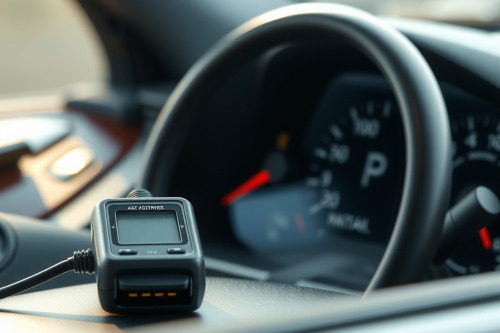
When an engine cranks endlessly without catching fire, throwing random parts at the vehicle only drains your wallet. Over 20 years on the shop floor taught me that you must diagnose car starting problems with an OBD2 scanner before pulling wrenches blindly. A capable diagnostic tool reveals whether your powertrain control module sees rotation, fuel pressure, or an anti-theft lockout. Hook your diagnostic tool to the port, leave the parts cannon in the toolbox, and let the live sensor telemetry pinpoint the root failure.
Initial setup to diagnose car starting problems with an OBD2 scanner
Roll your diagnostic workstation up to the driver door. A flat-rate tech knows that low system voltage ruins any electrical test before it starts. Connect your interface directly into the standard 16-pin diagnostic link connector under the dashboard. Turn the ignition switch to the run position without engaging the starter relay.
Check the battery voltage reading on the scanner display immediately. A resting lead-acid battery must show at least 12.4V to 12.6V to power up onboard computers reliably. If line voltage drops below 10.2V during cranking, digital control modules reset repeatedly. That voltage crash corrupts serial bus packets, mimicking catastrophic hardware failures. Connect a 50A clean power supply if the battery displays weak reserves.
Retrieving diagnostic trouble codes from the control modules
Start your diagnostic sequence by pulling current, pending, and permanent fault codes. Retrieving diagnostic trouble codes gives you the exact circuit or subsystem flagging an operational boundary fault. Write every code down before clearing anything. Never wipe trouble codes on a non-running engine, or you delete freeze frame records showing critical fuel trims, engine load, and operating temperatures recorded when the fault tripped.
Pay close attention to codes in the P0300 to P0340 bracket. These indicators point directly toward timing, misfires, or missing synchronization between rotating assemblies. If you pull a P0335, the powertrain control module can't register engine position. Without that critical timing baseline, the fuel injectors will never fire. Clear logic beats wild guesses every single shift.
How to diagnose car starting problems with an OBD2 scanner using live data
Static trouble codes tell only half the story. You must master live data stream interpretation while the engine cranks to isolate stubborn faults. Select custom data parameters rather than loading all generic telemetry PIDs at once. Loading 40 data streams simultaneously chokes the scan tool refresh rate down to 2Hz, causing you to miss transient signal dropouts.
Monitoring engine cranking speed
Select engine RPM as your primary visual graph. Crank the engine over for 5 seconds continuously. The scanner must show steady engine rotation between 180 RPM and 250 RPM driven by the starter motor.
If the tachometer display registers a flat 0 RPM while mechanical components clearly spin, you found your fault. A crankshaft position sensor signal failure prevents the computer from validating mechanical rotation. The control unit refuses to energize the ignition coils or pulse injectors because it assumes the crankshaft sits stationary.
Verifying ignition voltage and immobilizer status
Observe the security indicator PID on your display. An anti-theft system in tamper mode cuts injection pulses after 1 second of cranking. If your immobilizer shows active or unauthorized key status, no amount of starter fluid will solve the fault. Check computer power feed relays next if data drops out during key rotation.
Checking fuel delivery and ignition timing sync
Modern direct-injection gasoline systems demand massive hydrostatic pressures before firing high-impedance injectors. An engine crank no start condition often stems from high-pressure fuel starvation rather than failed ignition components. Pull up high-pressure and low-pressure fuel rail data lines together.
Watch the fuel rail pressure sensor readings closely while the starter engages. Low-pressure lift pumps must supply between 45 PSI and 72 PSI up to the engine bay. The mechanical high-pressure fuel pump should ramp pressure beyond 500 PSI during cranking cycles. If fuel rail pressure stays flat at tank pressure, the computer will disable fuel delivery entirely to protect precision mechanical tolerances.
Avoiding the diagnostic rabbit hole to cut down bay time
Unskilled mechanics waste hours testing good wiring harnesses instead of checking basic sensor rationales. You waste precious bay time when chasing phantom issues across multiple control networks. Do not fall into a diagnostic rabbit hole because of a misleading sensor reading.
Cross-check ambient air temperature against engine coolant temperature sensors when the car sits stone-cold. Both sensor values must read within 2°C of each other. A shorted coolant sensor reporting 140°C on a freezing morning will drastically lean out cold-start fuel enrichment. The engine starves for fuel simply because bad data corrupts cold-start calculation loops.
Final inspection advice and preventing comebacks
Rushing through troubleshooting leads to mistaken component swaps, wasted budget, and angry vehicle owners. A seasoned mechanic relies on a disciplined process to diagnose car starting problems with an OBD2 scanner rather than busting knuckles on unnecessary teardowns. Keep your tool software updated to decode manufacturer-specific extended PIDs accurately. Verify raw physical signals with a secondary test whenever serial data presents illogical numbers, ensuring solid results and preventing comebacks. Pick up your diagnostic scanner, read live cranking metrics, and solve your no-start issue right the first time.