
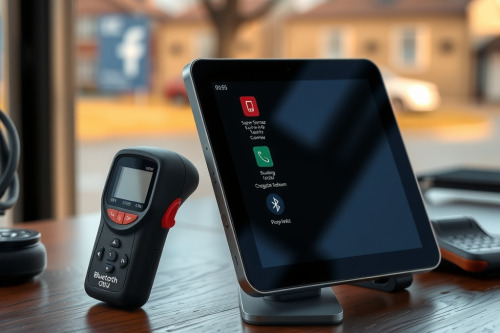
When you're busting knuckles for 10 hours a day, tool latency costs real money. I have wasted hours chasing a diagnostic rabbit hole simply because a cheap wireless dongle dropped packets mid-stream. Deciding between Bluetooth OBD2 scanners vs. professional diagnostic tablets comes down to throughput, control, and billable hours. Let us look at what happens when these tools hit real work in the service stall.
Bluetooth OBD2 scanners vs. professional diagnostic tablets: Architecture and speed
The core difference between these tool tiers begins at the hardware level. A pocket-sized wireless dongle relies entirely on your personal phone or consumer tablet to process calculations, while transmitting frames through a wireless protocol. That wireless hop introduces measurable lag. Under standard SAE J1979 queries, a basic wireless adapter typically pushes 8 to 15 parameter IDs (PIDs) per second. When you log high-speed fuel trim corrections against engine speed, that slow rate creates massive gaps in your graphs.
A dedicated shop unit runs on dedicated processing boards built strictly for heavy bus loads. These systems talk directly to the CAN bus protocol using isolated multiplexers. When hooked to the data link connector, a professional unit pulls 60 to 100 PIDs per second across multiple control modules simultaneously. When your paycheck depends on finding an intermittent misfire on cylinder 4, sample rate is everything.
Live data refresh rate and communication stability
Communication drops kill flat-rate tech productivity faster than rusted suspension bolts. Wireless dongles operating on standard 2.4 GHz frequencies constantly battle interference inside modern repair facilities. Overhead LED drivers, wireless tire balancers, and shop routers congest the airwaves. A dropped connection during a standard sensor read is annoying, but a dropped link during a module handshake can brick an expensive component.
Hardware tablets run ruggedized vehicle communication interfaces (VCIs) with dual-band transceivers or point-to-point wired USB connections. That industrial link ensures steady communication during continuous road testing. If you're logging transmission slip under 80% throttle on the interstate, you can't afford a disconnected app.
Bidirectional controls and component actuation
Code pulling tells you where the computer thinks a fault exists, not what caused it. A driver claiming their air conditioning blew warm might lead you to a dozen potential failures. A basic OBD2 scanner only reads the low-side pressure fault code stored in the powertrain control module. It cannot command the clutch to engage.
This is where professional units prove their worth for preventing comebacks. You get full bidirectional controls to test components on demand. With a few taps on the rolling cart screen, I can command a variable displacement compressor valve, command the radiator cooling fan to 100% duty cycle, or energize a shift solenoid right from the driver seat. Confirming mechanical movement under command isolates wiring breaks from defective actuators in under 5 minutes.
Advanced ECU coding and module setup capabilities
Modern repairs rarely end with bolting the new part into place. Swapping an electronic steering rack, replacing an ABS pump, or dropping in a fresh body control module demands direct ECU coding and configuration. Consumer-grade wireless adapters completely lack the onboard memory and authorization certificates required to write configuration files into modern security gateways.
Professional diagnostic tablets integrate routine service resets with secure gateway authentication protocols like FCA AutoAuth and European manufacturer portals. They execute steering angle sensor calibrations, injector flow rate registration, and diesel particulate filter regenerations cleanly. Attempting these procedures with budget tools will leave the vehicle stranded on your lift with limp-mode warnings glowing on the instrument cluster.
Bay time economics for the working flat-rate tech
Every piece of gear in your roll cab must pay for its drawer space. A compact wireless dongle costs between $40 and $120, making it an outstanding glovebox companion for quick triage or used-car lot sweeps. It pulls basic generic codes without dragging out heavy hardware. If you're inspecting a vehicle in the parking lot, a pocket adapter saves valuable steps.
For frontline bay time, the math shifts instantly. Spending $1,500 to $4,000 on a heavy-duty diagnostic tablet feels steep on day 1. However, shaving 25 minutes off every drivability job adds 3 to 5 billable hours to your weekly pay flag. Over 1 year, the diagnostic platform returns its buy price multiple times over through accurate diagnostics and avoided misdiagnoses.
Choosing between Bluetooth OBD2 scanners vs. professional diagnostic tablets
Match your equipment investment directly to your daily workload requirements. If your work involves basic oil maintenance reminders, reading generic emissions trouble codes, and casual weekend projects, a quality Bluetooth dongle paired with a clean phone app handles the job. It offers dependable data without clearing out your tool budget.
If you make your living solving tough drivability complaints, diagnosing networked module faults, and flashing replacements, invest in a dedicated commercial platform. Secure a dependable automotive scan tool with bidirectional capabilities, keep your software subscriptions active, and eliminate diagnostic guesswork on your next ticket.