
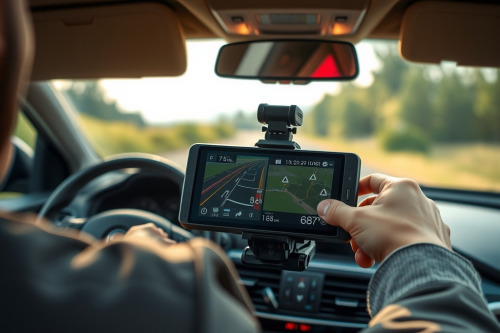
Mounting a flimsy phone mount to your air vent fails the moment heat spikes shut down your device in heavy traffic. Over 12 years of evaluating navigation electronics taught me that cockpit hardware demands dedicated silicon, high-gain antennas, and active thermals. Securing the best gps navigation for car setups requires prioritizing raw radio performance over flashy interface animations. You need hardware that locks signals in concrete canyons and runs reliably through blistering summer heatwaves.
Display Optics and Defeating Glare Washout on the Highway
Direct sunlight obliterates cheap navigation screens within seconds on open asphalt. You can't afford to squint at highway interchanges while operating at 110 km/h. Optical bonding between the glass layer and the panel prevents internal bounce-back reflections that ruin readability. Look specifically for panels rated at minimum 700 nits of peak luminance.
Touchscreen Technology Under Direct Sun
Resistive displays handle thick driving gloves, but they sacrifice light transmission and visual clarity. Modern cockpit systems favor projected capacitive panels equipped with polarizing film treatments. High humidity and dashboard heat cycles frequently induce capacitive ghosting, generating false touch inputs that disrupt route guidance. Opt for automotive-grade digitizers engineered with wet-finger tracking algorithms and localized electrical grounding.
Sun shields help, yet display hardware must carry the load. An anti-reflective matte coating cuts surface reflections by up to 85% compared to untreated gloss glass. Pair that with a robust patch antenna inside the housing to make sure internal hardware matches high-grade glass.
Satellite Triangulation and Tracking Across Difficult Terrains
A dependable gps navigation unit must maintain positioning when line of sight collapses. Standalone GPS frequencies suffer heavily in mountainous corridors and urban canyons surrounded by steel framing. Multi-constellation chipsets that process GPS, GLONASS, Galileo, and BeiDou simultaneously give important signal redundancy. More tracked birds means faster fixes and lower drift errors.
Multi-GNSS Reception Benchmarks
Standard single-band receivers pull positioning fixes from roughly 8 to 12 overhead satellites at any given moment. Modern multi-band dual-frequency modules acquire 24 to 36 satellites concurrently under identical atmospheric conditions. This dense signal triangulation drops horizontal position uncertainty from 5 meters down to less than 1.5 meters. Tight accuracy prevents your map marker from jumping onto parallel service roads unexpectedly.
Dead Reckoning Hardware for Tunnel and Canopy Coverage
Satellite signals drop completely the moment your vehicle enters a subterranean tunnel or multi-level parking structure. Low-end units freeze instantly on your last known coordinate. The best gps for car deployments avoids this failure state by utilizing integrated sensor fusion boards directly inside the enclosure.
Internal Inertial Measurement Units
Dead reckoning uses internal 3-axis gyroscopes, 3-axis accelerometers, and vehicle speed inputs to calculate your exact trajectory without active radio reception. The system measures steering angle shifts and wheel ticks to update your vehicle icon along the digitized vector map. As soon as you exit underground passes, the receiver reconnects without losing navigational context or missing immediate turns.
Processing Power and Preventing Rerouting Loops
Nothing ruins cross-country schedules faster than a navigation system stuck recalculating missed exits. Weak microprocessors create crippling latency lag when dynamic traffic feeds suggest sudden alternate courses. Instant recalculation demands multi-core processing architecture and ample RAM caching.
Algorithmic Route Planning and Turn Caching
Cheap car navigators process alternate routes linearly, choking memory bandwidth whenever traffic forces an unexpected lane split. Systems engineered for preventing rerouting loops calculate 3 viable branch trajectories simultaneously in background threads. If you bypass an exit, the system engages the secondary cache within 400 milliseconds. Fast processing eliminates agonizing delays while speeding through complex multi-tier freeway interchanges.
Mounting Mechanics and Thermal Longevity on the Dash
Dashboard temperatures regularly exceed 65 degrees Celsius during mid-day summer driving sessions. Lithium-ion batteries swell rapidly under sustained heat soak, warping casings and creating persistent fire hazards. Commercial vehicle operators bypass internal lithium batteries entirely, selecting supercapacitor-buffered units hardwired to vehicle power.
Rigid Ball Mounts vs Suction Brackets
Plastic suction cups lose vacuum pressure whenever cabin temperatures swing drastically between night and day. Heavy navigation heads require 25mm rubberized ball-and-socket arm systems anchored directly to dash substrate bolts. Solid mounting hardware isolates sensitive inertial sensors from chassis vibration harmonics, ensuring accurate vehicle pitch and roll measurements across broken pavement.
Final Inspection Protocols for the Best GPS Navigation for Car Fleets
Choosing the best gps navigation for car travel comes down to thermal resilience, receiver sensitivity, and processing responsiveness. Inspect the hardware casing for passive aluminum heat spreaders before mounting any unit permanently to your vehicle. Avoid consumer devices lacking dedicated multi-constellation firmware or unbuffered battery designs. Hardwire your navigation system directly to an ignition-switched fuse tap and test your signal lock under dense tree cover today.