
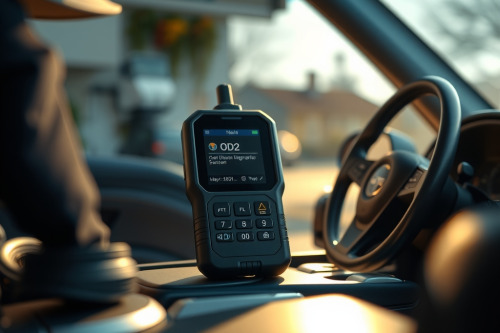
Tossing parts at an intermittent CAN communication fault bleeds billable hours fast. After 20 years busting knuckles on flat-rate work, I know cheap code readers will strand you in a diagnostic rabbit hole. You need a dedicated OBD2 scanner with advanced diagnostic functions that commands systems directly rather than just reading generic fault codes. Let's break down the exact hardware architecture and software coverage your bay demands.
Why An OBD2 Scanner With Advanced Diagnostic Functions Matters In Modern Bays
Modern vehicles roll into the shop packing 40 to 90 control modules interconnected across multiple baud rates. A baseline code puller only speaks generic emissions protocols on ISO 15765-4. That reveals zero operational insight when a customer hauls in a late-model truck with steering angle sensor deviations, body control faults, or blind-spot radar dropouts. Diagnosing these complex network glitches requires deep level module access across high-speed CAN, low-speed CAN, and Ethernet protocols like DoIP.
As a flat-rate tech, your income relies entirely on closing tickets accurately without re-checks. When an instrument cluster goes dark or an adaptive cruise system disengages, network topology mapping proves mandatory. A strong platform analyzes bus load, detects missing node IDs, and isolates CAN bus network diagnostics down to individual branch terminations in minutes. Shaving 45 minutes off diagnostic isolation time directly preserves your shop throughput.
Core Capabilities: Bidirectional Control Scan Tool And Active Testing
Reading data passively is half the battle. You can't determine whether a component failed or its control driver shorted without commanding the circuit directly. This requires a dedicated bidirectional control scan tool capable of forcing output states across engine, body, chassis, and safety modules.
Verifying Mechanical Actuators On The Fly
Commanding variable valve timing solenoids, purging evap canisters, or cycling cooling fans at 30%, 60%, and 100% duty cycles removes the guesswork entirely. When an engine stumbles under load, we use active test capability to run manual cylinder cut-out tests at 1,500 RPM. If dropping cylinder 4 causes zero RPM delta while the injector click remains audible, you immediately target ignition or base mechanical compression rather than chasing harness gremlins.
Stopping Parts Darts With Active Test Capability
Real diagnostic accuracy demands actuation without disassembly. Forcing the fuel pump relay to run at 4 bar while monitoring line pressure proves pump integrity instantly. Toggling HVAC blend doors through 0 to 100% sweep cycles confirms physical door travel versus stripped plastic actuator gears. Skipping this step turns routine repairs into expensive comebacks that eat shop profit margins.
ECU Coding And Programming Vs Basic Adaptations
Replacing a module today involves far more than mounting brackets and clipping harness connectors. Factory replacement modules often ship blank or unconfigured. Equipping your station with an OBD2 scanner with advanced diagnostic functions ensures you complete the entire installation workflow in-house rather than subletting the vehicle to a dealer.
Offline Coding vs Online J2534 Flashing
Basic service tools stop at throttle adaptations and brake pad retractions. High-tier diagnostic rigs handle ECU coding and programming through integrated J2534 Pass-Thru interfaces or direct online OEM server synchronization. Variant coding configures replaced door control modules to match chassis options like power folding mirrors, ambient lighting, and window anti-pinch thresholds. Proper flashing capabilities eliminate diagnostic roadblocks when resolving factory software calibration updates.
Component Matching And Variant Configuration
Calibrating modern steering angle sensors, diesel particulate filter resets, and dual-clutch transmission clutch-touchpoint learning requires precision routine execution. An advanced platform executes step-by-step relearn sequences while monitoring transmission oil temperature between 60°C and 80°C. Halting adaptation midway due to incomplete scan routines creates unshiftable transmissions and locked parking brakes.
Real-Time Telemetry: Live Data PID Graphing And Refresh Rates
Static PIDs often lie during transient faults. Glitches happen across milliseconds, well beneath the update capabilities of low-cost microcontrollers. A capable scan tool processes data at 25 to 50 samples per second across multiple data points simultaneously, revealing micro-dropouts that generate misfires.
Review live data PID graphing on four merged screens to diagnose oxygen sensor performance against short-term fuel trim reactions. A sluggish zirconia sensor taking 900ms to switch between 100mV and 900mV indicates contamination long before the PCM trips a P0133 DTC. When secondary ignition patterns or high-speed sensor wave forms show severe anomalies, we verify circuit integrity directly using a lab oscilloscope at the sensor connector pin to avoid false condemnations.
Evaluating The OBD2 Scanner With Advanced Diagnostic Functions For Shop ROI
Buying professional diagnostic equipment is a capital investment, not a hobby buy. Look at the balance sheet: recovering 3 lost hours of bay time every week generates thousands in billable labor over a 12-month period. Hardware longevity and update policies matter just as much as screen resolution.
Consider these hardware and operational benchmarks before parking a platform on your rolling cart:
- Processor speed and architecture: Minimum 8-core CPU running on a modern operating system with 4GB RAM to prevent menu lag during live sensor sweeps.
- Communication interfaces: Native CAN-FD and DoIP protocols built directly into the VCI connector without clumsy external adapters.
- Battery reserve: High-capacity lithium-ion pack delivering at least 8 to 10 hours of continuous runtime without dropping wireless connection mid-reflash.
- Software maintenance costs: Transparent annual subscription pricing that doesn't lock access to previously downloaded software if the subscription lapses.
Field Verdict: Selecting The Best OBD2 Scanner Setup
Diagnosing modern vehicles requires tools built for severe workshop environments, not delicate consumer electronics. Investing in an OBD2 scanner with advanced diagnostic functions bridges the gap between guessing and definitive component isolation. Prioritize bidirectional actuation, native CAN-FD protocol support, and high sample rate telemetry when outfitting your toolbox. Evaluate your weekly repair orders, audit your sublet calibration costs, and select an advanced diagnostic system that keeps high-margin work inside your bay.