
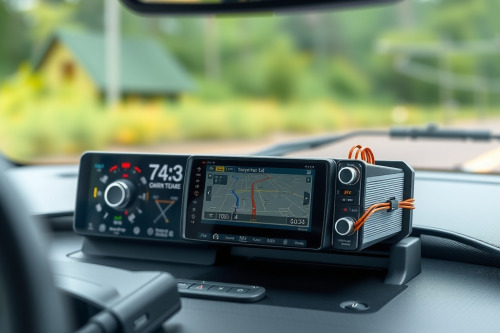
After 15 years servicing long-haul vehicle rigs and field-testing dash setups, I've seen too many drivers gamble on dying dash units. Sluggish processors and blind satellite locks create serious roadside hazards when you miss critical freeway splits. It's definitively time to upgrade your old hardware before complete chip failure strands your vehicle. Here is how you diagnose the failure points of your aging gear.
Critical signs it's time to upgrade your old hardware
Silicon degrades under constant thermal cycles. Your windshield acts like a solar oven, heating electronics past 65°C every summer afternoon. An aging car navigator begins dropping basic interface commands under these thermal loads. Cold boot times stretch from 15 seconds to 3 minutes. That sluggish behavior is not a software quirk. Internal flash memory blocks fail permanently after thousands of write cycles, corrupting stored base maps.
Internal power instability
Lithium cells inside dash gear don't last forever. An internal lithium-ion battery swells over time, pushing against the display assembly and cracking delicate solder joints. When the unit shuts down instantly upon pulling the 12V plug, your backup power circuit is toast. Throwing money at a failing legacy GPS unit makes no economic sense. That loss of volatile memory forces a cold satellite search every single ignition cycle.
Satellite triangulation failures and positioning drift
Clean positioning requires continuous multi-constellation tracking. Older receivers rely on antique 12-channel designs that drop connections between urban high-rises. When your device struggles with signal triangulation, your vehicle icon jumps erratically across parallel frontage roads. Modern GPS navigation hardware tracks GPS, GLONASS, and Galileo simultaneously across 60 or more concurrent channels.
Modern receiver sensitivity reaches down to -165 dBm. Older antennas drop signal when passing dense tree canopies or wet overpasses. Once lock fails, the receiver recalculates blindly. That computational thrashing turns highway exits into pure guesswork.
Display degradation: glare washout and touch glitches
Old resistive displays belong in the scrap bin. Sunlight readability on older screens rarely exceeds 300 nits, causing total glare washout in midday sun. Squinting at washed-out map vectors while running 70 mph invites disaster.
Touch responsiveness also deteriorates mechanically. Years of baking under ultraviolet rays causes micro-cracking across digitizer layers. This mechanical breakdown triggers capacitive ghosting, where phantom inputs register without human contact. The map zooms erratically or re-centers hundreds of miles away while you drive.
Processing bottlenecks and latency lag on the highway
Modern routing engines process massive map databases packed with multi-lane vector graphics. An outdated navigation device relies on 400 MHz single-core architecture unable to keep pace with rapid lane changes. You turn onto an off-ramp, yet your screen shows you 200 meters behind your actual physical position. This latency lag directly causes missed turns in high-density urban interchanges.
Complex highway corridors demand instant recalculation. Modern chipsets excel at preventing rerouting loops that trap drivers in endless circular paths when construction blocks an arterial exit. Outdated processors simply freeze when calculating alternate vectors across 5 alternative paths simultaneously.
Why modern gps navigation handles dead reckoning better
Signal loss inside tunnels or subterranean parking garages is inevitable. Advanced systems integrate internal gyroscopes and 3-axis accelerometers for continuous dead reckoning. Even with zero satellite visibility, modern hardware calculates exact heading and vehicle velocity down to 1% error margins. Old dash bricks lack these integrated motion sensors, leaving you blind the second you enter a tunnel network.
Finding the best gps navigation for car applications means checking hardware specifications thoroughly. Look for multi-frequency L1 and L5 band support. Dual-frequency reception eliminates atmospheric signal delays, pinpointing your car lane within 30 centimeters on complex interchanges.
When to upgrade your old hardware for highway safety
Reliability outweighs sentimentality when driving cross-country. Test your dash gear against modern benchmarks. If cold locks take over 90 seconds, or the screen dims under direct summer glare, you're running on borrowed time. Deciding to upgrade your old hardware restores road confidence and gives you responsive multi-touch panels, robust thermal management, and reliable multi-satellite tracking to secure the best gps for car travel.
Inspect your dash mount, measure power draw, and retire obsolete silicon before your next cross-country haul. Pull your aging car navigator from the windshield today and replace it with dependable, industrial-grade navigation gear.