
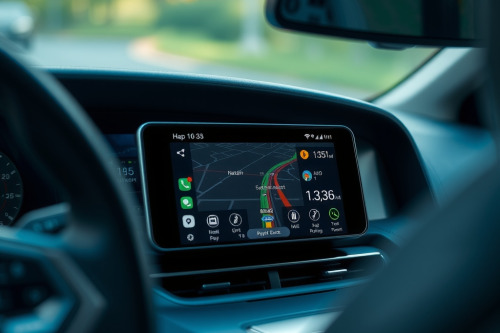
Mobile phones turn into useless glass bricks the second cell towers drop out along remote canyon trails. After testing rigs through 400km of unmapped mountain passes, I saw phones drop positional locks completely. Dedicated car navigators in dead zones solve this vulnerability by locking directly to multi-constellation orbital satellites without carrier towers. Choosing the best gps for car setups guarantees real-time routing when cellular radios fail.
Hardware Architecture of Car Navigators in Dead Zones
Consumer smartphones rely heavily on Assisted GPS (A-GPS). Cell towers feed ephemeris data to your phone modem to speed up satellite acquisition. Take away the tower signal, and phone modems struggle to complete raw patch antenna reception through dense tree canopy. The internal receiver searches blind across frequencies.
Dedicated RF Front-Ends vs Shared Cellular Modems
Smartphones cram cellular, Wi-Fi, Bluetooth, and satellite antennas into a chassis measuring under 8mm thick. Standalone units house an isolated ceramic patch antenna paired with high-gain low-noise amplifiers. This hardware calculates signal triangulation directly from GPS, GLONASS, and Galileo constellations without external cellular handshakes. Dedicated receivers update at 10Hz, eliminating the positional latency lag common to throttling consumer phone chips.
Sensor Fusion and Dead Reckoning Without Cellular Pings
Tall rock faces and dense tunnels choke satellite lines of sight. Consumer phones lose positional confidence immediately when radio beams bounce off cliff sides.
Maintaining Trajectory Under Solid Canopy
Dedicated automotive hardware relies on integrated dead reckoning. Built-in 3-axis gyroscopes, accelerometers, and speed-pulse inputs track physical wheel movement when sky visibility hits 0%. Standalone navigation hardware continuously calculates vehicle trajectory across darkened tunnels and canyon switchbacks. You maintain uninterrupted turn-by-turn awareness on the screen while phone mapping software freezes entirely.
Thermals and Display Engineering on the Dash
Direct summer sunlight kills standard phone batteries. Windshield mounts expose phone chassis to temperatures exceeding 65C within 20 minutes.
Beating Cabin Heat and Glare
Phones dim their screens or shut down completely to prevent thermal runaway. Automotive units feature ruggedized cooling fins, high-temperature capacitors, and batteries engineered for operational limits past 85C. Matte transflective screens push 700 nits to eliminate glare washout under blistering afternoon sun. Wet hands and dusty trails trigger capacitive ghosting on standard glass, whereas automotive resistive screens register physical inputs accurately every time.
Route Calculation and Preventing Rerouting Loops
Streaming map applications download terrain data in small vector tiles. Drive outside cell range, and missing map caches leave you staring at gray grid squares. The best gps navigation for car systems stores 100% of topological and street vector databases on onboard solid-state storage.
Local Storage Processing Advantages
Onboard quad-core processors crunch routing graphs locally. Missing an off-grid turn triggers an instant recalculation within 2 seconds instead of spinning a network wheel. Local map engines excel at preventing rerouting loops on isolated switchbacks where dead ends confound cellular algorithms. Dependable gps navigation requires zero cloud intervention to compute safe turnarounds.
Deploying Car Navigators in Dead Zones for Remote Field Runs
Reliability hinges on proper mechanical installation. Mount the hardware low on the center dash to maintain an unobstructed 120-degree horizon view through the windshield. Hardwire the power converter to a switched 12V or 24V fuse tap rather than depending on loose 5V cigarette adapters that rattle out on corrugated gravel. Run a complete onboard database firmware update over your home network before departing cell boundaries.
Equipping your truck with dependable car navigators in dead zones ensures survival when remote routes leave cellular networks behind. Inspect your vehicle power delivery, calibrate internal compass sensors, and secure your standalone dash mount before your next expedition.