
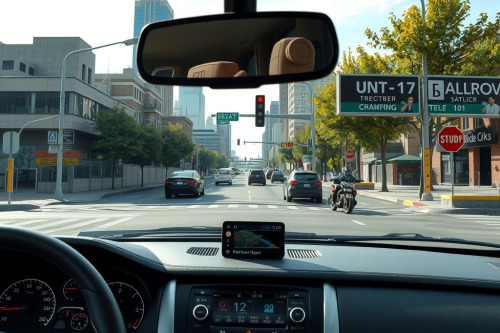
Standard phone map apps consistently fold under concrete overpasses, leaving drivers blind at critical split-ramps. Through 12 years of road-testing automotive telemetry, we've seen cheap units trigger catastrophic wrong-way diversions. Successfully navigating complex urban intersections requires purpose-built hardware capable of processing dense multi-path satellite feedback. Treat your dashboard navigation interface as critical vehicle telemetry before hitting urban bottlenecks.
Hardware requirements for navigating complex urban intersections
Urban canyons trash standard mobile phone receivers. Tall steel skyscrapers reflect high-frequency L1 satellite signals before they reach your windshield, inducing massive positional drift. Dedicated automotive receivers rely on multi-band GNSS arrays running alongside internal inertial sensors.
When satellite lock drops in triple-deck interchanges, internal 3-axis sensors take over. A calibrated gyroscope pairs directly with vehicle wheel speed sensors to maintain tracking continuity. This onboard dead reckoning system calculates your spatial position down to 1.5m accuracy without receiving an active satellite ping. Without this hardware redundancy, tracking accuracy disintegrates rapidly.
Overcoming satellite multipath interference and signal loss
High-density metro corridors choke standard radio frequency signals. The primary receiver requires strong signal triangulation across GPS, GLONASS, Galileo, and BeiDou networks simultaneously. Poorly shielded antennas invite spurious reflections that scramble road-matching algorithms.
Weak chipsets cause severe latency lag when calculating coordinates between elevated highway ramps. A lag of 250ms at 100km/h shifts your calculated position by nearly 7m across adjacent expressway dividers. Dedicated processors maintain a constant 10Hz refresh rate to eliminate that dangerous visual stutter. Clean positioning keeps the map marker locked on your actual highway lane. Multi-channel RF front-ends effectively discard reflected ground noise before digital data hits the calculation pipeline.
Display visibility under harsh cabin conditions
Harsh ambient light hitting your windshield directly destroys cheap consumer screens. Direct sunlight generates intense glare washout across low-grade glass panels. Automotive grade displays must output at least 800 nits of continuous backlight brightness to combat direct sun.
Optical bonding between the protective glass and the TFT panel eliminates reflective internal air gaps. High humidity and direct defrost air vent streams frequently trigger capacitive ghosting across inferior touch layers. Physical rotary dials or resistive digitizers prevent erratic screen inputs when you tap lane prompts. Clear junction views demand high-contrast anti-reflective coatings that remain readable at wide 45-degree viewing angles.
Firmware strategies for navigating complex urban intersections
Fast hardware fails without aggressive onboard routing logic. Missing a high-speed exit on an 8-lane elevated beltway causes bad firmware to enter a calculating freeze. Smart firmware focuses immediately on preventing rerouting loops that trap drivers on endless circular off-ramps.
Top-tier gps navigation software caches vector road layouts directly on fast solid-state storage. Local storage access slashes compute times from 6 seconds down to 0.4 seconds. Split-screen visual lane guidance displays active overhead gantry signage identical to the physical road environment. That situational clarity stops erratic lane hopping before complex split junctions.
Best gps navigation for car deployment and cockpit setup
Mounting position dictates hardware reliability on the asphalt. Securing the best gps navigation for car applications requires rigid dashboard suction arms or solid bolted ball mounts. Cheap gooseneck holders vibrate under heavy chassis rumble, shaking display markers out of focus.
Route a stable 12V direct-wire line with transient voltage suppression directly to your auxiliary fuse block. Dropping line voltage below 10.8V forces random chipset reboots in congested traffic. The best gps for car setups pairs this isolated power feed with unobstructed dashboard sky exposure. Clean installs protect hardware longevity during grueling cross-country runs.
Final inspection protocol for road navigation gear
Inspect your mounting hardware and firmware revisions before embarking into dense metropolitan grids. Dependable systems prevent erratic maneuvering during high-speed junction merges. Test cold-start time-to-first-fix benchmarks in an open parking lot before your morning departure. For drivers regularly navigating complex urban intersections, dedicated hardware remains non-negotiable insurance against chaotic traffic networks. Audit your cabin cabling, lock in offline map database updates, and configure your cockpit telemetry today.