
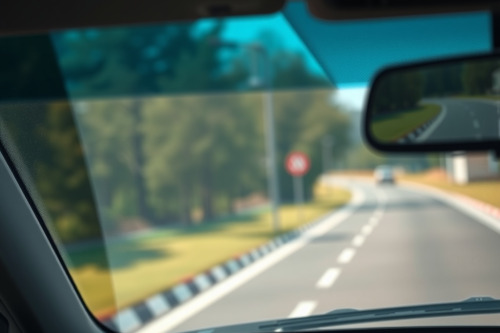
You mount a fresh receiver on the dash, punch in coordinates, and watch satellite acquisition crawl at 0 knots. I see this failure across test rigs constantly after drivers apply aftermarket metallized films to automotive glass. We need to dissect the real tinted windshield GPS signal impact before you blame your satellite hardware. Radio frequency signals at 1575.42 MHz cannot punch through dense metallic barriers without suffering immediate packet drops.
Physics of Tinted Windshield GPS Signal Impact on Dash Units
Passive dash antennas rely on unobstructed line-of-sight tracking. Sputtered metal films reflect solar heat by sandwiching microscopic particles of aluminum, bronze, or titanium between polyester layers. That metal layer behaves like a compromised Faraday cage directly across your front glass. Incoming L1 band signals drop by 8 dB to 15 dB instantly upon contact.
Lower signal-to-noise ratios compromise lock stability across the horizon. When raw signal reception falls below 28 dB-Hz, precision geometry collapses. The system struggles with basic signal triangulation because it can't synchronize timecodes from 4 operational birds simultaneously. You end up waiting 5 minutes just to establish an initial position lock.
Metallized Films vs Ceramic Barriers: Field Observations
Not all aftermarket glass treatment creates identical attenuation profiles. In bench tests, standard dye films and nano-ceramic coatings show minimal RF interference, typically cutting under 1.5 dB of signal gain. High-performance metallized coatings act entirely differently on the road.
RF Attenuation Across Common Window Layers
Standard clear laminated glass delivers negligible insertion loss around 0.5 dB. Add heavy metallic vapor deposition, and signal attenuation surges past 12 dB. This drop eliminates weaker satellite links entirely. You maintain overhead coverage, but low-elevation locks disappear behind the horizon line.
Display Visibility and Glare Washout
Drivers install dark film to avoid interior heat and display glare washout under direct sunlight. While darker glass boosts cabin screen contrast, poor RF transmission cripples the underlying receiver. Finding the best gps for car setups requires balancing screen nit ratings against radio transparency. If the glass blocks the antenna, high screen brightness solves nothing.
Hardware Diagnostics: Identifying Latency Lag and Lost Fixes
When antenna reception degrades, internal processor polling rates stall. Position drift becomes obvious when sitting at a dead stop at a traffic junction. Your map icon stutters, floats across parallel roads, and triggers false corrections.
This drop causes severe latency lag during high-speed highway interchanges. The processor waits for valid satellite packets, misses turns, and introduces critical navigation delays. Without continuous positional data, the processor fails at preventing rerouting loops that spin drivers in circles. High cabin heat under tinted surfaces also triggers capacitive ghosting on cheap digitizers, causing phantom route inputs.
Mounting Adjustments and Tinted Windshield GPS Signal Impact Workarounds
You can bypass heavy glass attenuation without stripping your car window film. Most OEM vehicles leave an untreated RF pass-through matrix near the rearview mirror mount. Black dotted frit zones often lack heat-reflective metal coatings.
Relocating Dashboard Receivers
Shift your hardware mount into this dotted boundary zone immediately. Elevating the receiver by 200mm to clear the tint margin restores up to 6 dB of signal strength. Test reception levels using raw satellite status menus before permanently routing power cables. Small shifts in chassis placement deliver massive improvements in tracking confidence.
Deploying External Active Antennas
If your cab glass is fully coated with metal film, internal mounting will fail consistently. Run a dedicated MMCX or SMA remote antenna puck to your roofline. External placement completely eliminates tinted windshield GPS signal impact by capturing untouched satellite constellations. The roof metal then acts as a positive ground plane, boosting overall antenna gain by 3 dB.
Selecting Dedicated Hardware for Challenging Cabins
Consumer smartphones feature tiny patch antennas with limited filtering circuits. Dedicated standalone car navigation hardware delivers higher reception sensitivity through multi-band GNSS tracking. Modern units track GPS, GLONASS, Galileo, and BeiDou frequencies simultaneously to maintain positioning lock.
For heavily shielded cockpits, choose the best gps navigation for car use that includes integrated inertial sensors. Premium units rely on hardware dead reckoning, using 3-axis gyroscopes and speed pulses to bridge tracking gaps when signal triangulation drops out completely. This keeps your vehicle tracked securely through tunnels and dense metal-shielded zones without signal drift.
Field Recommendations for Stable Signal Acquisition
Never deploy dash hardware blindly after getting custom automotive glass installed. Pull up the diagnostic satellite status page on your gps navigation device to inspect individual carrier-to-noise numbers. If your overhead satellite links struggle below 30 dB-Hz, tinted windshield GPS signal impact is actively choking your radio module. Move the antenna to the rear quarter glass, shift to the mirror frit area, or wire an external patch antenna to your roofline today.