
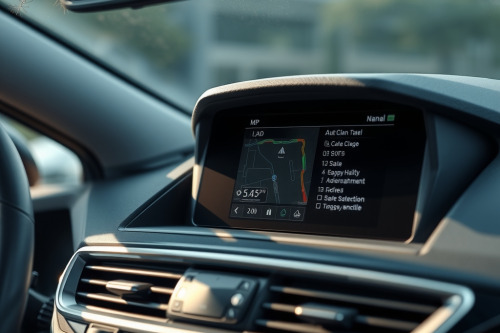
Staring at a spinning location icon while parked on the tarmac leaves you stranded without dependable turn-by-turn guidance. During my 12 years bench-testing automotive infotainment systems, I found that when a car navigator fails to acquire a satellite lock, hardware obstruction or stale ephemeris tables are almost always responsible. You do not need to replace your entire dashboard console to fix this reception failure. A systematic diagnostic check will pinpoint the breakdown and get your positional tracking working within minutes.
Core reasons a car navigator fails to acquire a satellite lock
Satellite positioning demands line-of-sight communication between your vehicle and at least 4 orbital satellites. GPS signals broadcast on the L1 band at 1575.42 MHz, delivering a carrier power of roughly -130 dBm at ground level. This radio frequency link is faint. Dense concrete parking decks, deep urban canyons, and heavy cloud cover severely attenuate these micro-signals.
Hardware obstacles inside the cabin compound the issue. Windshields fitted with metallic thermal films or embedded defroster wires degrade high-frequency signals by 12 dB to 18 dB. If the internal receiver can't detect signals above the ambient noise floor, the positioning engine halts completely.
GPS almanac data corruption after long inactivity
Navigation receivers store almanac and ephemeris tables to predict orbital positions. These mathematical models remain accurate for about 4 hours for fine tracking and 14 days for broad trajectory data. Leaving your vehicle parked in an underground garage for 3 weeks produces GPS almanac data corruption. The receiver searches historical orbital coordinates that no longer match reality overhead. It takes 15 to 45 minutes of open-sky exposure to download a completely fresh broadcast frame at the standard 50 bits per second data rate.
Field troubleshooting for a lost satellite signal
Begin with physical environment control before unfastening dash trim. Drive the vehicle out of dense structures into an open expanse clear of tall buildings or overhead high-voltage transmission lines. Park the vehicle, shift into park, and keep the engine idling to maintain stable 12V rail power.
Executing a cold start navigation reset
Modern head units retain corrupted mathematical states in volatile memory. Cut this memory cycle short. Access the service menu of your receiver or disconnect the battery negative lead for 10 minutes to force a cold start navigation reset. This operation wipes stale positional assumptions, forcing the internal baseband processor to scan raw frequencies from scratch.
Eliminating electromagnetic cabin interference
Third-party cabin accessories radiate substantial radio-frequency interference. Unregulated USB fast chargers, dashcams with poorly shielded ribbon cables, and radar detectors leak noise directly into the 1.5 GHz spectrum. Power down every aftermarket accessory plugged into your 12V sockets. If your unit instantly locks onto 7 satellites after unplugging a dashcam, you have found the emitter.
Software workarounds when a car navigator fails to acquire a satellite lock
Software deadlocks frequently freeze tracking calculations. When internal calculations hang, GPS receiver troubleshooting requires clearing cached ephemeris tables through software interfaces rather than physical electrical cuts.
Purging cached satellite ephemeris data
Enter your navigation application settings and locate the location services menu. Clear the cache partition directly. Standstill tracking engines frequently lock up when trying to reconcile stale speed vectors with stationary receiver inputs. Clearing this data table prompts the tracking algorithm to build a fresh 3D fix without processing conflicting legacy waypoints.
Firmware updates and patch deployment
Automotive manufacturers routinely issue system updates addressing GPS week roll-over vulnerabilities. Older satellite receivers track time using a 10-bit binary parameter that rolls over every 1024 weeks. Outdated firmware misinterprets the satellite clock cycle, causing the baseband processor to reject valid incoming signals. Check your manufacturer support portal and flash the newest official firmware release via USB drive.
Hardware inspection and external GPS antenna installation
Factory dash-integrated antennas deteriorate from extreme cabin temperature cycles. A cracked housing allows moisture to corrode active low-noise amplifier (LNA) circuitry. Inspect the antenna cable route behind the dashboard to ensure the line hasn't pinched against structural metal braces.
Test the continuity of the