
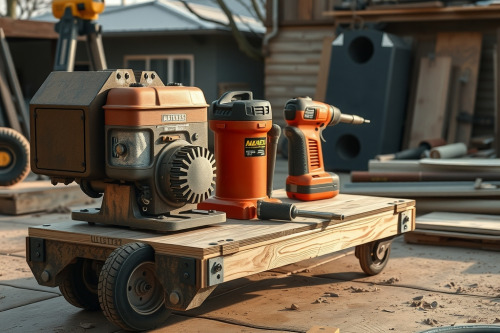
Lugging a 45kg table assembly across an uneven concrete garage floor destroys your back and ruins alignment. Over 22 years of custom millwork, I discovered that building a mobile cart is the only permanent solution for cramped workshop layouts. A flimsy utility trolley flexes under load, creating critical alignment failures during heavy milling operations. Build your rolling workstation with structural mass, or prepare to fight cut inaccuracies every single day.
Structural framing rules when building a mobile cart
Pocket screws alone fail under 60kg machines. We build shop frames with 19mm Baltic birch plywood or double-layered cabinet-grade sheet stock. Cut wide half-lap joints on all load-bearing stretchers to handle dynamic lateral force. Deflection must remain under 1mm across an 800mm span. Rigid framing keeps tool tables dead flat when rolling over rough floor joints.
Glue every joint with waterproof structural adhesive. Clamp the carcass square with 4 heavy parallel clamps, checking corner-to-corner diagonals within a 0.5mm tolerance. Adding internal gussets to the lower shelf stops racking completely. Cheap cart builds shudder during heavy stock feeds, ruining fine work.
Mounting the wood router and managing severe vibration
Dropping a 3-horsepower motor into a mobile base demands extreme mass. Even the best wood router will transfer severe motor harmonics through a thin cart top. We laminate 2 layers of 19mm dense sheet material to construct a solid 38mm mounting deck. Any honest wood router review confirms that high vibration spoils surface finishes and loosens critical mechanical fasteners.
Heavy motor vibration causes collet slip on deep cuts. Clean the motor shank and collet cone with lacquer thinner to strip packing grease. Torque the collet nut down to 35Nm using matching drop-forged wrenches. Solid base dampening prevents bit drop and protects your workpiece.
Mobility mechanics and caster selection for rough floors
Small hard wheels stop cold on wood chips. Install 100mm total-lock swivel casters outfitted with thick polyurethane tires to absorb vibration. Mount each wheel using 4 through-bolts backed with 25mm steel fender washers.
Leveling systems
Wheels move, but machines must stay planted during cuts. Thread 12mm steel leveling feet through threaded inserts beside each wheel plate. Crank the feet down to elevate the cart 3mm off its wheels before powering on. Zero rolling movement guarantees clean, repeatable results.
Building a mobile cart dust management and airflow system
Enclosed router cabinets become fire traps without engineered airflow. Build a lower chamber around the power head, leaving 50mm clearance on all sides. We bore a 100mm port into the rear panel directly behind the cutter spindle. Hook that port directly to a 2-horsepower cyclone collector.
Poor extraction causes a severe dust collection choke in 2 minutes of running deep dados. Add a 63mm extraction line straight to the fence guide to grab surface swarf. Clean airflow stops the motor from overheating while keeping the enclosure free of packed sawdust.
Operational adjustments to eliminate bit chatter and tear-out
High feed rates test the rigidity of any rolling station. When running dense 25mm hard maple, anchor your stance and push the timber firmly into the fence. If your cart shifts a mere 0.5mm, violent bit chatter ripples through the cut edge immediately. Secure the leveling base to keep cut paths straight.
Divide heavy passes into 3 separate steps to maintain target profile depth safely. Trying to hog out 12mm of timber in 1 pass causes deep tear-out along wild edge grain. Pushing timber too slowly leads to burning the stock instantly. Maintain a firm, constant 3-meter-per-minute feed speed across the cutter face.
Field inspection protocol before cutting
Inspect every structural component before plugging into main power. Check all caster mount bolts with an open-end wrench to confirm zero play. Shove the cart frame hard with your hip; any detectable frame flex means your leveling pads need manual adjustment. Test run a 300mm scrap piece of scrap pine to confirm smooth operation.
Executing a deliberate plan for building a mobile cart gives you commercial-grade precision inside a standard home garage. Source industrial casters, laminate your work surfaces thick, and secure your floor leveling pads before starting your next cabinetry build.