
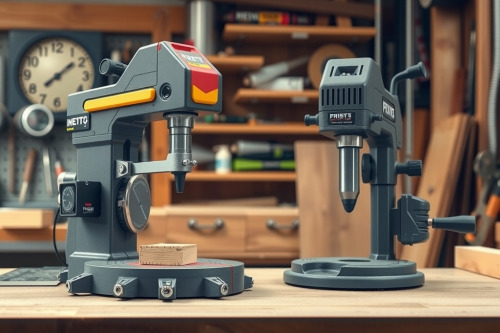
Ruining an expensive slab of 8/4 walnut because your depth shifted mid-pass is an unforgiving rite of passage in woodworking. After 25 years milling millwork profiles on commercial jobsites, I've seen beginners wreck fine joinery Using the wrong tool for the task. Understanding the mechanical split between fixed-base and plunge trimmers prevents ruined stock, deadly kickback, and expensive rework. We must look at base stability, motor handling, and bit feed before you waste your tooling budget.
Mechanics of Fixed-Base and Plunge Trimmers
A fixed-base setup secures the motor housing inside a rigid cylinder using a threaded collar or rack-and-pinion clamp. You establish the cutting depth manually before flipping the power toggle. The motor stays put during operation. This mechanical lock provides superior rigidity against rotational torque.
How fixed bases hold static profile depth
When cutting a 6mm roundover along 20m of hard maple trim, stability is paramount. A fixed base holds its profile depth without creeping. The lower center of gravity keeps your palms closer to the workpiece surface. You get maximum tactile control on narrow edge faces.
How plunge mechanisms handle internal stopped cuts
A plunge base relies on 2 vertical steel guide columns packed with internal return springs. You release a thumb-lock lever, press the motor downward into spinning engagement, and lock it at your stop turret. It enables blind mortises and internal drop cuts without hazardous angled tip-ins.
Edge Profiling vs Internal Joinery: Matching the Cut to the Base
Using the wrong base configuration guarantees ragged cuts. Every finish carpenter learns this lesson the hard way.
Running roundovers without bit chatter
For dedicated edge moldings, the fixed configuration remains the champion. Plunge columns introduce minute flex when you push sideways against an edge guide. That microscopic movement causes bit chatter along grain transitions. A locked fixed unit keeps 100% of the sub-base flat against the stock face. It delivers glassy edges without chatter ripples.
Deep plunge operations and mortising passes
Do not try cutting 40mm mortises with a fixed base. Tipping a spinning 12mm spiral bit into white oak invites terrifying kickback. A plunge base allows stepped cuts in 3mm increments using an indexed turret stop. You plunge, rout your slot, release the lock, and pull out cleanly while the motor runs at full 22000 RPM.
Real Shop Diagnostics: Defeating Tear-Out and Collet Slip
Feed direction dictates surface finish. Always feed against bit rotation to prevent climbing unless you take a light 0.5mm cleanup skim. If you push stock too fast, you get severe grain tear-out on figured cherry. Move too slowly, and friction creates excessive heat, instantly burning the stock.
Motor torque means nothing if your shank breaks loose. Always clean solvent residue off the bit shank before securing it in the collet. Tighten firmly with dedicated forged wrenches. Never bottom out the bit shank against the motor arbor; leave a 2mm gap to prevent thermal expansion from causing severe collet slip mid-cut.
Dust Extraction and Preventing Dust Collection Choke
Chips packed inside a deep groove ruin cutting accuracy. When chips pack tightly against your cutter flute, heat triples within 3 seconds. The resulting dust collection choke traps abrasive waste, dulling premium carbide edges in minutes.
A dedicated plunge shroud captures upward debris plumes during heavy hogging. Fixed bases often push waste out laterally. Maintain at least 100 CFM airflow at the dust port to evacuate dense oak shavings cleanly.
Selecting Fixed-Base and Plunge Trimmers for Your Shop Bench
Every wood router review praises multi-base kits, and for good reason. A solid combo pack delivers 1 motor with both interchangeable bases. If your budget only allows 1 setup, assess your immediate projects honestly.
Cabinet door edging, flush trimming laminates, and chamfering require a compact wood router with a fixed base. Complex mortise-and-tenon work, fluting, and bowl carving demand a smooth plunge mechanism. Buying the best wood router kit with dual bases eliminates the compromise entirely. You can drop the fixed unit into a bench mount while keeping the plunge body ready for handheld cuts.
Final Verdict on Fixed-Base and Plunge Trimmers
Don't overcomplicate your purchase. If you specialize in edge treatments and joinery trimming, start with a 1.25 HP fixed-base palm unit. If you cut mortises, dados, and inlay patterns, invest in a 2.25 HP plunge tool immediately. When choosing fixed-base and plunge trimmers, inspect base flatness with a machined straightedge and test sub-base concentricity before leaving the store. Pick your platform, tighten your tooling properly, and run test scraps before cutting expensive stock.