
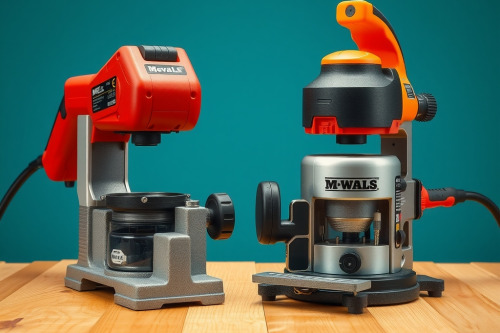
Ruining an 8/4 walnut tabletop with an errant gouge happens in less than half a second when you run the wrong machine setup. Over 25 years of running commercial millwork jobs, I've seen green apprentices wreck expensive stock because they didn't understand the mechanical division between fixed-base and plunge trimmers. Grabbing a random wood router off the staging shelf without matching motor balance to the cut path guarantees sloppy edge joinery and dangerous kickback. Let's dial in the base mechanics so you make the right choice on your next project.
Mechanical Breakdown: Fixed-Base and Plunge Trimmers Compared
Base architecture dictates how cutters engage timber. Fixed-base setups lock the motor inside a threaded aluminum sleeve or clamp collar. You adjust vertical cutter height by rotating the motor housing or cranking a fine-pitch helical gear. The motor stays rigid relative to the sub-base throughout every pass. That gives you maximum stability during perimeter cuts.
Plunge housings mount the powerhead on dual spring-loaded steel guide posts. You release a lever, shove the spinning bit down through the workpiece face, and lock the depth stop turret. Springs maintain counter-tension against your hands. Releasing the lock springs the cutter back above the base plate automatically. This mechanism gives plunge bases their distinct versatility for interior cutouts.
Stability and Center of Gravity
Center of gravity governs cut quality on narrow edges. Fixed bases sit lower to the bench by 35mm to 50mm compared to plunge units. That low profile prevents the machine from tipping when you ride a flush-trim bearing down 19mm face frames. Plunge units carry heavy springs and upper post castings high in the air. That top-heavy distribution invites rocking, which invariably causes uneven cuts and workpiece gouging.
Setting Profile Depth and Locking Down Cuts
Cutter positioning accuracy separates cabinet-grade joinery from rough framing work. On a fixed base, you dial the depth ring to thousands of an inch, lock the clamp, and verify against a test block. The spindle never moves dynamically during cut execution. Measuring bit runout with a dial indicator shows that rigid sleeve clamps produce less radial deflection than sliding plunge bushings.
Plunge bases rely on stepped stop turrets and threaded stop rods. You drop the bit until it kisses the lumber, zero the scale, and insert a brass depth stop block. That setup speeds up stepped mortising in 6mm increments. However, every moving post introduces minor clearance tolerances. If spring pressure pushes unevenly on worn brass sleeves, you lose repeatable profile depth across successive runs.
Jobsite Realities: Edge Profiling Work Versus Blind Mortising
Choosing the right tool demands matching cut geometry to base mechanics. Standard edge profiling work belongs on a fixed unit. Running a 12mm roundover bit along 30m of cherry casing requires uninterrupted flat contact. Your hands ride low on the sub-base, applying pressure inward against the fence or workpiece face. If you attempt this continuous perimeter run with a tall plunge base, wrist fatigue will cause the base to tip.
Blind mortising, stopped dados, and internal sign carving demand a plunge trimmer. Trying to tip a spinning bit into an interior cut on a fixed base invites violent kickback and burning the stock. Plunge units enter the wood vertically on center, track dead straight down guide rails, and pull out cleanly. Any thorough wood router review will confirm that entering deep cuts from above without a plunge spring is an unnecessary safety hazard.
Mitigating Bit Chatter and Collet Slip Under Load
Vibration destroys carbide cutters and ruins clean joints. Bit chatter occurs when spindle deflection excites resonance between the cutter flutes and the workpiece grain. Tall plunge columns magnify dynamic vibration when you make heavy lateral cuts with 1/2-inch shank bits. Run your feed rates steadily to ensure chips clear cleanly. Clean feeds eliminate motor bogging on tough white oak.
Preventing collet slip requires disciplined mechanical habits. Inspect your split collets for resin glazing and metal deformation weekly. Tighten the collet nut with properly sized, forged wrenches until it seats firmly without overtightening. A bit that shifts inside a loose collet climbs out of the cut instantly, cutting deeper than intended and damaging your workpiece. Never insert bit shanks flush against the bottom of the spindle socket; leave 3mm of clearance to prevent shank deformation.
Dust Collection Choke and Motor Longevity in Daily Service
Debris extraction affects cutter life and operator health. Plunge bases enclose the bit area with clear plastic shrouds to capture chips at the point of origin. When cutting deep mortises, high chip volume causes a dust collection choke inside tight vacuum hoods. The trapped chips recirculate inside the cut, causing friction and dulling your bit edges prematurely.
Fixed units run more open sub-bases, throwing chips outward into collection boots or shop vacuums. While open collection catches fewer ambient micro-particles, it prevents high-speed heat buildup around the cutter face. Heat transfer ruins tool steels. Clean your motor vents with 6 bar compressed air every afternoon to remove packed dust. Clean motors avoid thermal shutdowns during production runs.
Final Verdict: Deploying Fixed-Base and Plunge Trimmers on Site
Buying the best wood router setup for your shop comes down to production demands and task volume. If your workflow centers on joinery profiling, roundovers, flush trimming, and inverted table use, prioritize a rugged fixed-base machine. It gives you the lowest center of gravity, highest baseline accuracy, and fastest setup times on repetitive trim details.
If you build passage doors, mill custom mortise-and-tenon joints, or execute interior cutouts in hardwood panels, deploy a plunge unit. Its controlled vertical descent prevents dangerous entry slips and eliminates severe tear-out on delicate show surfaces. Inspect your machine bases for column play before your next milling run, lock your depth stops tight, and purchase the dedicated configuration your joinery demands.