
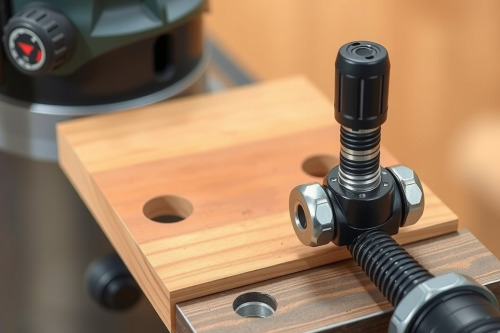
You clamp the plunge base down, feed your workpiece into the cutter, and suddenly notice a stepped groove ruining an expensive slab of white oak. After 25 years running commercial millwork lines, I know that sudden vertical drift rarely stems from a bad motor. More often than not, troubleshooting inconsistent depth cuts points directly to worn cam lock levers slipping under vibration. Catching this mechanical slop early saves expensive hardwoods from the scrap bin.

Mechanics of depth drift and clamp failure
Router motors generate severe axial thrust against the housing during heavy profiling passes. The clamping lever must overcome this continuous downward and rotational force by exerting uniform radial pressure around the motor body or plunge columns.
How vibration compromises clamping pressure
Metal fatigues over thousands of routing cycles. Cast aluminum bases stretch by 0.1mm to 0.3mm over time, while steel cam faces gradually grind flat spots into their mating pins. Once clamping force drops below the threshold needed to resist cutter engagement, the motor creeps. This micro-slippage causes rough dado floors, irregular rebates, and unacceptable dial indicator deviations under load. It quickly triggers jagged tear-out along delicate face grain.
Diagnostics for troubleshooting inconsistent depth cuts
Never guess whether a cut failed due to operator error or mechanical slop. You need objective measurements before stripping down the tool assembly.
Checking housing play on the bench
Unplug the tool and secure a straight bit in the collet. Mount a dial indicator to the router base with the probe tip resting against the lower motor casting. Clamp the locking lever down using normal operating force. Grab the motor housing with both hands and apply 15 kg of vertical pressure. Any needle deflection exceeding 0.05mm indicates that your clamp is no longer holding factory tolerances under load.
Differentiating lever fatigue from collet slip
New woodworkers frequently misdiagnose depth variations as collet failure. You must isolate the true mechanical cause before replacing functional hardware.
Identifying bit chatter and feed resistance
Bit slippage produces distinct warning signs. If the shank slips upward inside the cone, you'll see circular burnishing rings ground into the carbide shank. Collet slip introduces aggressive bit chatter that reverberates straight through the handles into your forearms. Conversely, if your bit shows zero slip marks but your final profile depth has stepped by 1.5mm, your base lock lever backed off during the pass. Forcing the feed when a bit chatters increases heat exponentially, burning the stock and ruining your cutter edge.
Troubleshooting inconsistent depth cuts through mechanical calibration
Restoring clamping friction takes 15 minutes at the workbench. Most quality bases use an adjustable pivot bolt or cam eccentric to compensate for normal wear.
Setting locking nut tension and clearing debris
Start by blowing out packed swarf from the split-collar gap. A severe dust collection choke packs fine sawdust behind the clamping pad, preventing full travel. Back off the retaining nut by 1 full turn, spray the cam with dry silicone lubricant, and inspect the friction washer. Tighten the locknut in 30-degree increments until the lever requires firm palm pressure to seat fully home. It should snap shut positively without bending the lever arm.
Selecting the best wood router base for long-term stability
When studying a detailed wood router review, look closely at base architecture rather than raw motor wattage alone. A high-amp motor is completely useless if the clamping collar flexes under dynamic cutter loads.
Base casting standards for production shops
The best wood router designs feature thick, ribbed magnesium or aluminum sub-bases equipped with oversized, forged steel locking levers. Avoid stamped-sheet cam levers that twist under heavy clamping pressure. A dependable wood router must hold absolute vertical registration throughout continuous 8-hour production runs without requiring mid-day adjustments.
Shop floor practices to prevent profile depth drift
Preventative maintenance eliminates unforced errors on high-value casework. Clean your plunge columns and motor sleeve with mineral spirits once every 20 operational hours.
Column lubrication rules
Never apply wet grease or standard motor oil to router columns. Wet lubricants attract abrasive sawdust, forming a grinding paste that rapidly wears down the cast bore. Use dry PTFE spray or bare, polished steel surfaces. Check your lever locking torque every Monday morning before starting critical joinery cuts.
Final checks for dependable milling
Methodical troubleshooting inconsistent depth cuts ensures your joinery stays crisp and your project stock stays out of the scrap bin. Regular base tension inspections prevent ruined workpieces and dangerous bit travel on the job site. Grab your shop wrenches, check your base tolerances today, and keep your depth settings dead accurate on every pass.