
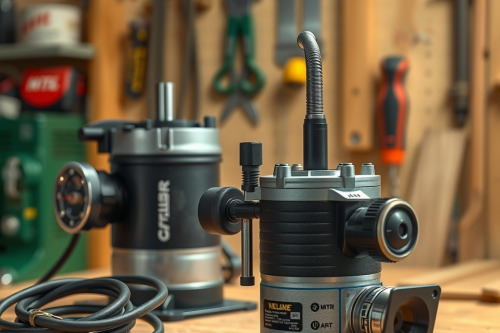
When your plunge or fixed-base machine begins fluctuating mid-pass, you risk ruining expensive lumber in seconds. After 25 years running commercial millwork shops, I know erratic motor RPM ruins profiles faster than dull carbide ever will. This guide breaks down troubleshooting variable-speed router motors so you can isolate electrical faults from mechanical binding on your bench.

Recognizing variable-speed motor speed regulation issues
Modern universal motors rely on solid-state feedback circuits to hold target velocity under cut resistance. A healthy wood router maintains consistent output whether trimming soft pine or slotting dense hard maple. When regulation fails, the motor hunts between high and low revolutions, yielding horrific bit chatter across your edge profiles.
Speed variation leaves immediate visual evidence on the timber. An uncommanded surge leads to severe tear-out when the cutters overtake the feed rate. Conversely, sudden router motor RPM drop causes excess friction against the spinning carbide, quickly burning the stock and ruining the bit's temper. If your machine refuses to hold 16000 RPM while chewing a 6mm profile depth, you face internal regulation trouble.
Diagnosing electronic speed control module symptoms
The core brain behind load stabilization is the electronic speed control module. This small encapsulated component reads armature speed and modulates voltage through a triac to maintain steady torque. Vibration and fine wood flour constantly degrade these sensitive electronics inside the housing.
Erratic potentiometer responses
Variable speed dial issues often manifest as dead bands across the numbered positions. You roll the dial from position 2 up to position 4 with zero perceptible change in sound pitch. Then, suddenly, the spindle spikes straight to 24000 RPM. Dirt or resin deposits frequently coat the carbon traces inside the dial assembly, severing signal transmission to the control board.
Module shutdown and sensor dropouts
Many modules integrate a magnetic hall-effect sensor or optical pickup positioned adjacent to the armature shaft. When dust collection choke conditions starve the upper motor bucket of clean cooling air, thermal buildup causes this pickup to send scrambled signals. The controller enters a protection loop, resulting in outright router speed control failure mid-pass.
Mechanical drag versus motor surging under load
Never condemn electrical components before eliminating simple mechanical resistance. Bearing failure mimics electronic decay with shocking regularity. Disconnect power, release the collet, and spin the spindle manually. The shaft must spin freely for at least 3 seconds with zero gritty resistance or radial play.
Worn carbon brushes also trigger false motor surging under load. Inspect both brush cartridges whenever velocity becomes erratic. If brush carbon measures under 6mm in total length, spring tension drops below operating specification. The brush bounces violently across the copper commutator bars, sparking intensely and starving the motor coils of stable voltage.
Field checklist for troubleshooting variable-speed router motors
Bench testing requires an organized process of elimination. Work through these sequential checks whenever your tool behaves unpredictably.
Step 1: Clean and verify supply voltage
Long or undersized 14-gauge extension cords cause brutal line voltage drop under 15A loads. Plug the tool straight into a verified 20A wall receptacle. Clear the upper ventilation louvers with dry compressed air regulated at 4 bar to flush caked fines away from the control PCB.
Step 2: Inspect mechanical interfaces
Examine the arbor assembly carefully. Dirt lodged inside the tapered cone induces collet slip, allowing bits to migrate downward and bog the drive train. Clean both the collet bore and bit shanks with solvent before retorquing nuts to 35 Nm.
Step 3: Test bypass and potentiometer continuity
Unplug the tool and access the motor wiring cavity. Measure resistance across the variable speed dial terminals using a standard digital multimeter. Resistance values should scale smoothly from about 0 ohms to 500k ohms without open-circuit spikes as you rotate the wheel.
Setup rules to prevent router speed control failure
Every wood router review praises raw peak horsepower, but longevity comes down to heat dissipation and clean power. Keep the motor running idle at minimum speed for 30 seconds after completing heavy profiling cuts to pull ambient air through the housing. Never wrap cords tightly around the motor casing, which stresses internal wiring leads.
Match bit diameter directly to factory speed ratings. Running a 50mm panel raiser above 12000 RPM overloads internal current limiters, cooking speed control sensors prematurely. Even the best wood router fails quickly when asked to force massive cutters through deep stock without multiple stepped passes.
Final shop advice on router motor maintenance
Solid troubleshooting variable-speed router motors comes down to systematic diagnosis rather than throwing random parts at the casing. Start by replacing $12 carbon brushes and blowing out caked resin before purchasing expensive replacement circuit boards. Pull your motor brushes now, inspect the commutator face for pitting, and clean those air vents before you fire up your next production run.